Every breed begins as an idea about what a horse could be. The Ameritano began with a question: what happens when the athleticism and cow sense of the Foundation Quarter Horse meet the grace and courage of the Portuguese Lusitano?
The answer took forty years of breeding to arrive at, and it is a horse that refuses to be confined to one arena.
What Is an Ameritano?
An Ameritano is the cross of a high-percentage NFQHA-certified Quarter Horse and a registered Portuguese Lusitano. Both halves of that definition matter. The Quarter Horse parent must carry documented Foundation bloodlines rather than modern performance breeding, and the Iberian parent must be a Lusitano specifically, not an Andalusian.
That precision is the entire point. It is what separates an Ameritano from the many other Quarter Horse and Iberian crosses, and it is why the horse needed a name of its own.
Why the Cross Needed a New Name
For decades, any cross between an American Quarter Horse and either a Portuguese Lusitano or a Spanish Andalusian was folded into a single category. Most were called Aztecas, after the national horse of Mexico. Others were registered simply as Half Breds with the International Andalusian and Lusitano Horse Registry.
Both labels were accurate in the loosest sense and useless in every practical one. They described a range of horses so wide that the name told a buyer almost nothing about what stood in front of them. A Lusitano crossed on an NFQHA-certified mare produces something specific and repeatable, and that consistency deserved a designation that reflected it.
How the Name Was Chosen
The name came together almost on its own. Take the beginning of American Quarter Horse and the end of Lusitano, and the result is Ameritano: both parents present in a single word, in the order they contributed.
There was a bonus hidden inside it. Spell the name out and the word MERIT sits in the middle of it, which anyone who has spent time around these horses will tell you is fitting.
Four Decades at Jaz Ranch
The Ameritano was developed at Jaz Ranch in Levan, Utah, over more than forty years of selective breeding.
What distinguishes the program is not the pedigrees it started with but the trait it prioritized. Conformation, movement, bone, and color were all selected for, as they are in any serious breeding operation. But the first filter was always the mind.
Marny Belt, a professional trainer who has worked with nearly every Ameritano the ranch has raised, put it this way: a horse can be beautiful in every measurable respect and still be difficult to live with. Genetics shape the brain as surely as they shape the hock. The dog world has long accepted that pairing an inexperienced handler with a high-powered intelligence is a mistake. Horses are no different, and a serious brain needs a serious job.
The Ameritano was bred to have that brain and to enjoy using it in company with a person.
What Each Parent Contributes
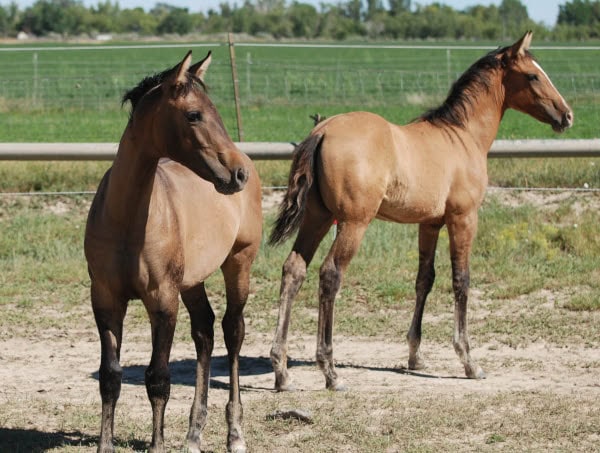
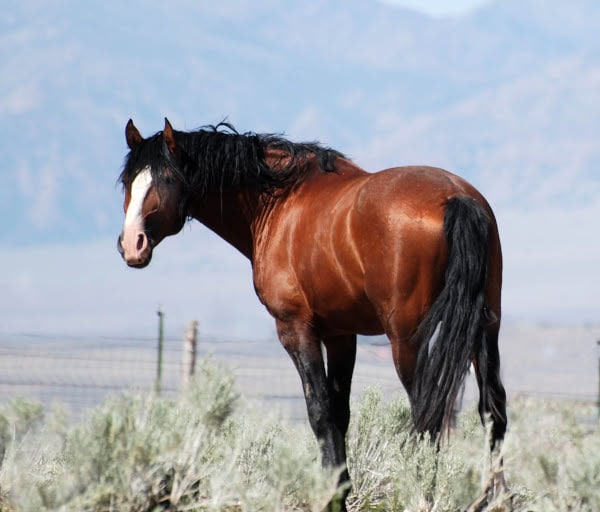
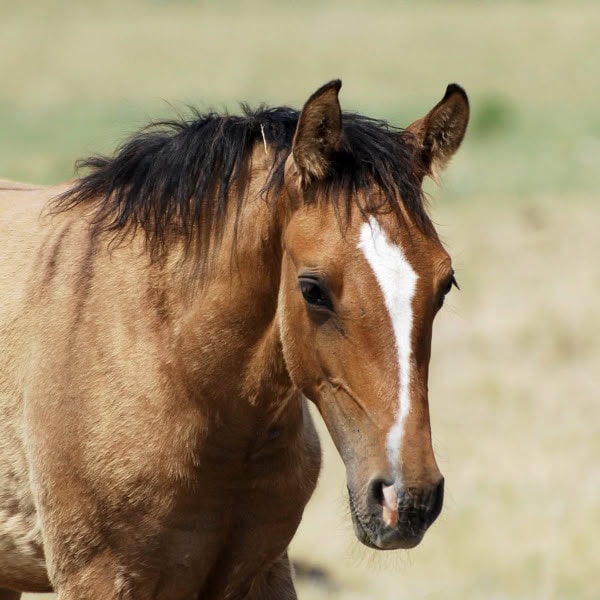
From the NFQHA Quarter Horse. Agility, cow sense, hardiness, good feet, and the legendary Foundation disposition. The goal in crossing is to add height, elegance, animation, and flexibility to that foundation without giving up an ounce of the athleticism or the temperament.
From the Lusitano. Courage, grace, collection, and lateral ability refined over centuries in the dressage arena and, before that, in war and in the bullring, where a horse’s instantaneous response to its rider was a matter of survival. The goal in crossing is a calmer spirit carrying more muscle and bone, with none of that responsiveness lost.
The result is a horse that moves comfortably between two worlds that rarely overlap: Western work and classical dressage.
Ameritano #1: Caballito de Acero
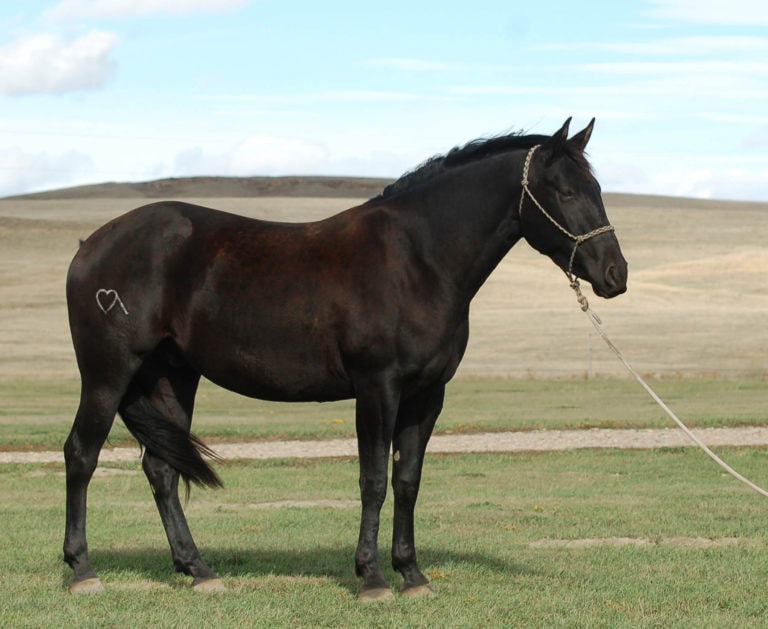
The first horse assigned an Ameritano registration number was Caballito de Acero, a black gelding by the Lusitano stallion Calido CD out of Heflins Steel Jaz, a 95% NFQHA mare and a full sister to Jaz Poco Goldun Blue.
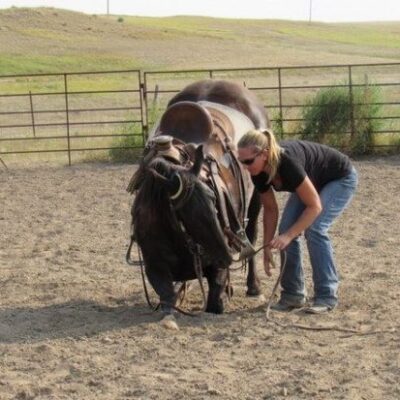
Acero belonged to Melissa Fowler of Buffalo, South Dakota, and in five years he became the argument for the entire breed. He had the conformation, the muscling, the bone, and above all the disposition the cross was created to produce. He worked cattle on the Fowler ranch, learned to bow, and did willingly whatever was asked of him. Melissa called him the best horse she had ever owned and said he was never for sale.
He sustained a fatal injury before the association was formally established. His number was assigned anyway. It seemed right that the horse who proved what an Ameritano could be should be the first one on the books.

The Breed Today
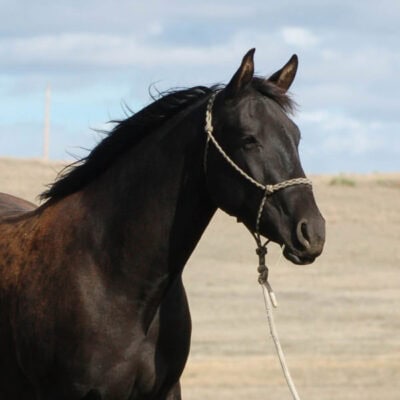
Ameritanos are now working cattle, competing in dressage and Working Equitation, riding hundred-mile trails, and standing in wedding photographs. The first Ameritano foal outside the United States was born in Germany, [CONFIRM: year], after breeders there saw the cross online, bought a Lusitano mare, and put her to their NFQHA stallion Mights Black Magic.
The Ameritano Horse Registry was established [CONFIRM: year and month] to record and validate the cross and to give it an identity independent of the Azteca and Half Bred designations. Registration is open to any horse meeting the parentage requirements, whatever ranch it was bred on.
That last point is deliberate. A breed built on a single ranch’s bloodlines has a ceiling, and the association’s hope is that more breeders take up the Ameritano, widen the gene pool, and carry the horse further than one program ever could alone.
Register Your Ameritano
If your horse is by a registered Lusitano out of an NFQHA-certified mare, or the reverse, it may already qualify. See the registration requirements, or contact us with questions about eligibility.